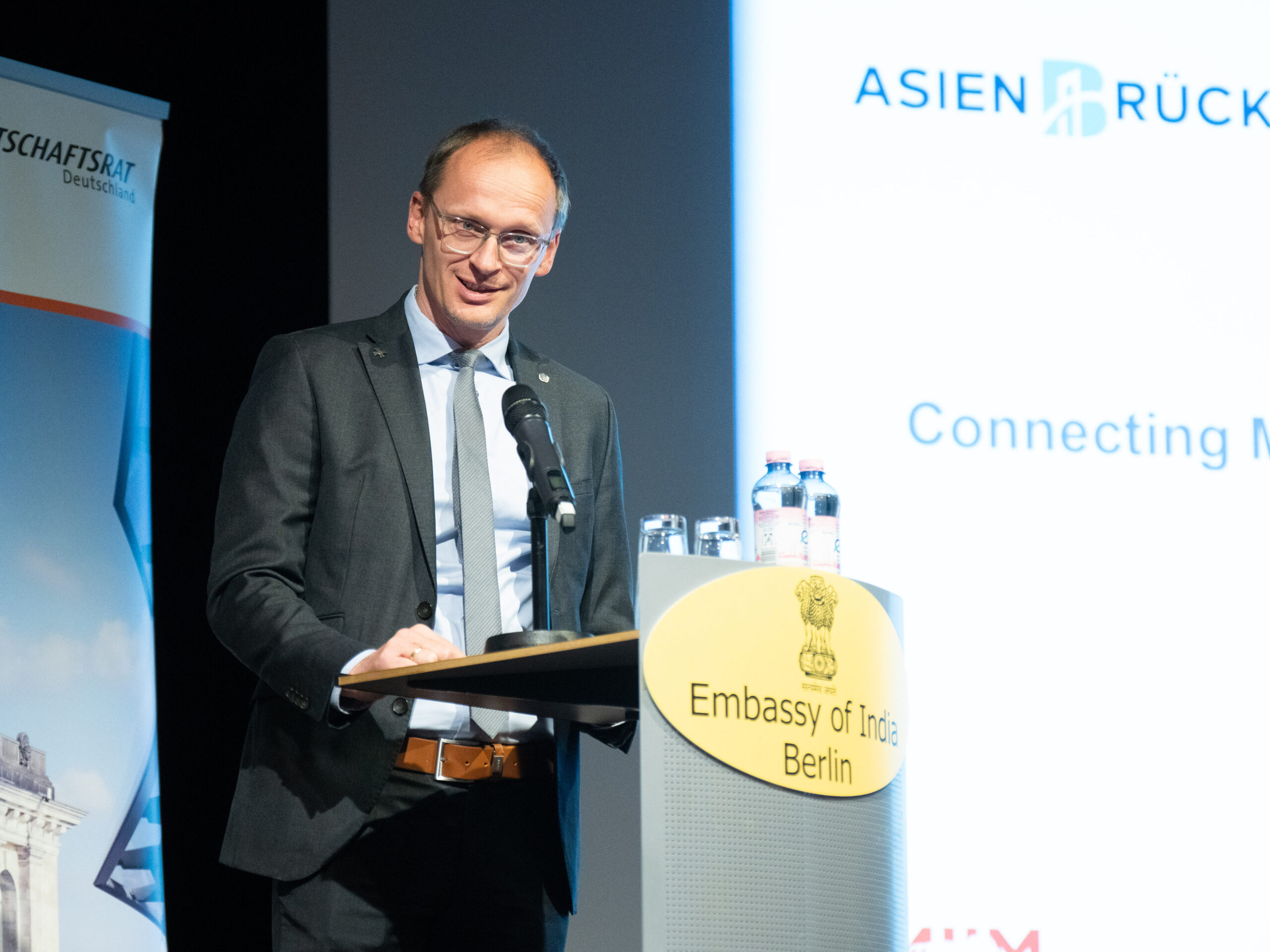
Am 09. September war ich auf Einladung der Asienbrücke e.V. und dem Wirtschaftsrat zu Gast in der indischen Botschaft in Berlin. Die Veranstaltung, die unter dem Titel „Connecting Markets: India and Europe in a new Era of Trade“ stand habe ich eine Rede zur deutsch-indischen Partnerschaft gehalten.
Die Rede als Volltext in englischer Sprache finden Sie im Folgenden.
„Your Excellency Ambassador Gupte,
distinguished guests,
ladies and gentlemen,
thank you very much for the invitation. It is a pleasure to be here at the Embassy of India in a year in which Germany and India celebrate 75 years of diplomatic relations.
As a member of the German-Indian Parliamentary Group, I am particularly pleased to be here today. In January, the European Union and India concluded negotiations on a landmark Free Trade Agreement after almost two decades of talks.
For me, the opportunity ahead can be described in three words:
Trade, technology and talent.
First: trade.
EU-India trade in goods and services reached around 185 billion euros in 2025. Yet India is still only the European Union’s ninth-largest trading partner.
That tells us two things: the relationship is already important, but it is still far below its potential.
The Free Trade Agreement can change the economics of this relationship. It will eliminate or reduce tariffs on 96.6 percent of EU goods exports to India and improve market access in important sectors. The European Commission expects EU goods exports to India to more than double by 2032.
But a trade agreement cannot substitute for investment.
German and European companies should see “Make in India” not only as a market-access challenge, but also as an invitation to invest, develop and innovate locally. The same openness should apply to successful Indian companies investing and scaling in Germany and across the European Single Market.
This is also why progress on the separate investment protection agreement matters.
Market access creates opportunity. Predictable rules create the confidence to invest for decades.
Second: technology.
As someone who works on digital policy in the German Bundestag, I believe this is one of the most promising parts of our partnership.
Trade in the 21st century is not only about moving cars, machinery or pharmaceuticals across borders.
Digital infrastructure is trade infrastructure.
Artificial intelligence, semiconductors and computing capacity increasingly determine how competitive our economies are.
The negotiated Free Trade Agreement already contains a dedicated chapter on digital trade. And the EU-India Trade and Technology Council is deepening cooperation in areas such as AI, semiconductors and advanced computing.
India brings enormous scale and one of the world’s most dynamic technology ecosystems. Europe brings industrial depth, research excellence and the scale of the Single Market.
The goal should not be for one side simply to sell technology to the other.
The goal should be joint development: common research, startup cooperation, interoperable solutions and resilient supply chains.
For me, technological sovereignty does not mean autarky.
It means having the ability to choose. And choice requires trusted partners.
Europe and India should increasingly become partners of choice for one another.
Third: talent.
This may ultimately be the most important bridge between our economies.
Almost 70,000 Indian students are now enrolled at German universities. India is the largest country of origin for international students in Germany.
But for me, these people-to-people ties are not just statistics.
In my own constituency in Schleswig-Holstein, many people with Indian roots are part of our local communities. And earlier this year, we had the pleasure of celebrating International Yoga Day in the German Bundestag together with Ambassador Gupte.
Moments like this remind us that the relationship between India and Germany is not built by governments and companies alone.
It is already part of our societies.
These ties create trust, professional networks and mutual understanding that no trade agreement can build on its own.
We should make much more of this strength: with faster and more predictable visa and recognition procedures, better pathways from university into employment and closer cooperation between universities and companies.
And mobility should work in both directions. I would also like to see more young Germans studying, researching and building careers in India.
A partnership becomes truly strategic when the next generation sees both countries as part of its own professional horizon.
Ladies and gentlemen,
India thinks long-term. Viksit Bharat (“Developed India”) sets a horizon of 2047 – 100 years after India gained independence and the target year for becoming a developed economy.
We should approach our partnership with the same strategic ambition. But long-term partnerships are built through decisions taken today.
So our task is clear:
A Free Trade Agreement on paper is only the beginning. Our task is to bring it to life with ambition and concrete cooperation.
Make progress on investment protection.
Turn technology cooperation into real projects and investments.
And treat talent mobility as a core part of economic policy.
Through the German-Indian Parliamentary Group, we should ensure that this economic partnership is backed by equally strong political trust and continuity.
The political window is open.
The economic logic is strong.
And the human links between our countries are growing stronger every day.
Now we have to create scale.
India should no longer be described merely as Europe’s great market of the future.
It is already a strategic economic partner of the present.
Our task is to give that partnership the scale it deserves.
And Europe should aim to be the same for India.
Thank you very much.“